Industrial axial fans are among the most widely deployed mechanical equipment in manufacturing, process, and infrastructure environments worldwide. They move air or gas parallel to the rotation axis of the impeller, generating high airflow volumes at relatively low static pressure, making them the preferred ventilation and cooling solution wherever large quantities of air must be moved efficiently through open or lightly obstructed flow paths. Their combination of high airflow capacity, compact axial installation profile, and energy efficiency at low to medium pressure duties has made them the standard specification for factory floor ventilation, heat exchanger cooling, cooling towers, tunnel ventilation, and process air supply across virtually every industrial sector.
The direct conclusion for anyone specifying an industrial axial fan is this: the axial fan is the correct choice when the application requires large volumes of air at low to moderate static pressure, and when the available installation space favors an inline or propeller type mounting rather than a ducted centrifugal system. The critical specification variables are airflow rate, available static pressure, blade pitch and diameter, motor power and efficiency class, and the environmental protection and material specification appropriate for the operating atmosphere. This article covers all of these factors with the technical depth required for informed specification and selection decisions.
How Industrial Axial Fans Work?
The operating principle of an axial fan is the generation of lift on the impeller blades as they rotate through the air, in the same way that an aircraft propeller or helicopter rotor generates thrust. Each blade is an aerofoil profile that creates a pressure difference between its two faces as it moves through the air: the face pointing in the direction of intended airflow experiences lower pressure, and the opposite face experiences higher pressure. This pressure difference drives air in the axial direction, from the low pressure upstream side to the high pressure downstream side, creating the characteristic through the axis airflow that distinguishes axial fans from centrifugal fans.
Blade Geometry and Its Effect on Performance
The aerodynamic performance of an axial fan impeller is determined by the blade's aerofoil profile, its chord length (the width of the blade from leading to trailing edge), its pitch angle (the angle of the blade chord relative to the plane of rotation), and the number of blades. These parameters interact to determine the fan's airflow rate, pressure generating capability, efficiency, and noise characteristics at any given rotational speed:
- Blade pitch angle: Higher pitch angles increase both the airflow rate and the static pressure generation of the fan at a given rotational speed, at the cost of higher power consumption and increased noise. Many industrial axial fans are designed with adjustable blade pitch to allow the same impeller to serve different duty points without changing the fan speed or motor. Variable pitch fans can adjust airflow from near zero to maximum without variable speed drives, providing significant operational flexibility.
- Aerofoil blade profiles: Purpose designed aerofoil blade sections (similar to aircraft wing profiles) provide significantly higher aerodynamic efficiency and lower noise than flat or paddle shaped blades. Aerofoil blades generate more lift per unit of drag, allowing the fan to move more air for a given power input. Quality industrial axial fans use aerofoil blade profiles machined or cast to precise tolerances.
- Number of blades: Fewer blades (typically 4 to 8 for large industrial fans) generally produce lower noise than many bladed designs at the same airflow rate, because the blade passing frequency is lower. More blades per impeller can improve pressure generation and reduce individual blade loading, but also increase manufacturing cost and the potential for noise if blade spacing is uneven.
Fan Laws: How Speed, Airflow, and Power Relate
The performance of any axial fan at different operating speeds follows the fundamental fan laws, which define fixed mathematical relationships between speed, airflow, pressure, and power. Understanding these relationships is essential for anyone specifying variable speed drives for industrial axial fans or for predicting performance at off design conditions:
- Airflow varies directly with speed: Reducing fan speed to 80 percent of its rated speed reduces airflow to 80 percent of rated airflow.
- Static pressure varies with the square of speed: Reducing fan speed to 80 percent reduces static pressure to 64 percent of rated pressure.
- Power varies with the cube of speed: Reducing fan speed to 80 percent of rated speed reduces motor power consumption to just 51 percent of full speed power, making variable speed drives one of the most cost effective energy saving measures available for industrial fan systems where full airflow is not always required.
Types of Industrial Axial Fans
Industrial axial fans are produced in several physical formats that differ in their installation configuration, performance characteristics, and suitability for specific applications. The main categories in commercial and industrial use are:
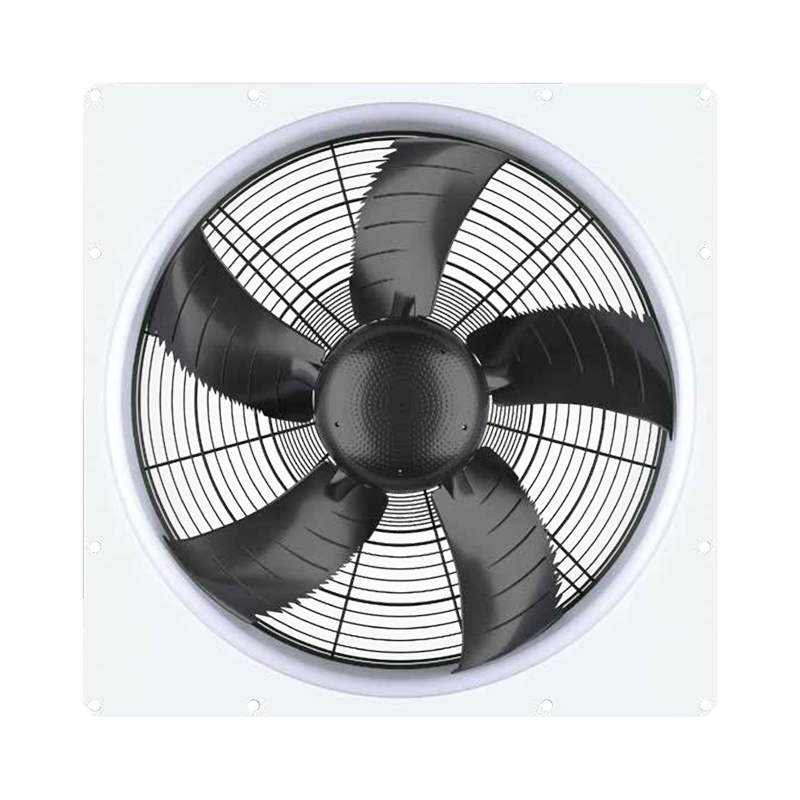
- Propeller fans: The simplest form, consisting of a motor mounted impeller without a surrounding tube or casing, installed in a wall opening or panel. Propeller fans are the lowest cost format and are suited to applications requiring large airflow volumes at very low or zero static pressure, such as factory ventilation through open wall apertures and equipment cooling panels. They cannot develop significant pressure and should not be used in ducted systems where resistance must be overcome.
- Tube axial fans: The impeller is enclosed within a cylindrical casing of similar diameter, which improves aerodynamic efficiency by reducing tip leakage between the blade tips and the surrounding air. Tube axial fans develop moderate static pressure and are suitable for inline duct installation in low resistance ventilation systems and process air supply applications.
- Vane axial fans: A tube axial fan with the addition of inlet and outlet guide vanes (fixed blades) that improve the aerodynamic efficiency of the impeller by removing the swirl component from the discharged air. Vane axial fans achieve higher static pressures and better efficiency than tube axial designs, making them suitable for more heavily resisted ducted systems. In side by side testing, vane axial fans typically achieve 15 to 25 percent higher static pressure efficiency than equivalent tube axial fans, justifying their higher cost in energy intensive continuous duty applications.
- Bifurcated axial fans: A specialized design in which the motor and its cooling system are located outside the main airflow path, with the motor driving the impeller through a shaft that passes through a dividing structure in the casing. This configuration allows the fan to handle high temperature air or corrosive gases that would damage a standard motor if exposed to the airstream. Bifurcated fans are the standard specification for commercial kitchen extract systems and industrial process gas extraction applications where the handled air exceeds the motor's temperature or chemical resistance limits.
Key Applications of Industrial Axial Fans
The high airflow capacity and energy efficient operation of industrial axial fans at low to moderate static pressure makes them the preferred specification across a wide range of heavy industrial, process, and infrastructure sectors:
Cooling Towers and Heat Exchangers
Cooling towers use large diameter axial fans, typically 1 to 5 meters in diameter, to drive air through water cooled packing or through fin and tube heat exchanger coils. The low resistance of the air path through a cooling tower or dry cooler makes axial fans the only practical and energy efficient choice for this application; centrifugal fans would require disproportionately large motors for the same airflow at the negligible static pressures involved. Modern large cooling tower axial fans with aerofoil blades and variable pitch adjustment achieve total efficiencies of 70 to 85 percent at the design duty point, compared to 40 to 55 percent for older flat blade designs of the same diameter.
Industrial Building and Factory Ventilation
Manufacturing facilities, warehouses, logistics centers, and process buildings require large volumes of fresh air for heat removal, fume dilution, and worker comfort. Industrial axial propeller fans and tube axial fans mounted in roof panels, wall apertures, and inline duct sections provide this ventilation economically. The direct drive propeller fan format (motor shaft directly coupled to the impeller hub, without gearbox or belt drive) is the standard for most industrial ventilation applications because of its simplicity, reliability, and low maintenance requirement.
Tunnel and Metro Ventilation
Road tunnels, railway tunnels, and metro systems require powerful axial fans capable of generating sufficient air velocity through the tunnel to dilute vehicle exhaust gases and remove heat from train traction systems. Reversible axial fans are used in these applications so that airflow direction can be reversed in emergency smoke extraction scenarios, driving smoke away from the evacuation route regardless of which tunnel portal is the escape path.
Petrochemical and Process Industry
Air cooled heat exchangers (fin fan coolers) in refineries, petrochemical plants, and gas processing facilities use large axial fans to drive ambient air across fin and tube bundles that cool process streams. These fans operate continuously in demanding environments and require corrosion resistant materials, ATEX rated motors for potentially explosive atmospheres, and variable pitch or variable speed control to maintain cooling duty as ambient temperature varies through the seasonal cycle.
Industrial Axial Fan Specifications: Performance and Selection Reference
| Fan Type |
Typical Airflow Range (m3/h) |
Static Pressure Capability (Pa) |
Typical Efficiency |
Best Application |
| Propeller fan |
500 to 100,000 and above |
0 to 30 |
40 to 60 percent |
Open panel ventilation, general air movement |
| Tube axial fan |
1,000 to 150,000 |
10 to 100 |
55 to 70 percent |
Low resistance duct systems, process supply |
| Vane axial fan |
1,000 to 200,000 |
50 to 500 |
65 to 80 percent |
Industrial HVAC, tunnel ventilation, process extract |
| Bifurcated axial fan |
500 to 80,000 |
20 to 300 |
50 to 65 percent |
Kitchen extract, hot gas handling, corrosive extract |
| Cooling tower fan |
50,000 to 2,000,000 and above |
10 to 80 |
70 to 85 percent |
Cooling towers, dry coolers, air cooled condensers |
Material Selection and Environmental Considerations
Industrial axial fans operate in environments ranging from clean air in food factories to highly corrosive atmospheres in chemical plants, from ambient temperature in warehouse ventilation to elevated temperatures above 200 degrees Celsius in process gas extraction. Material selection for the impeller, casing, and motor must be matched to these conditions to ensure the specified service life and maintain performance over the operational period.
- Aluminum alloy impellers: The standard material for most commercial and medium duty industrial axial fans. Aluminum offers a good strength to weight ratio, adequate corrosion resistance in most non aggressive atmospheres, and ease of casting or machining to precise aerofoil profiles. Not suitable for strongly acidic, alkaline, or chloride rich environments.
- Stainless steel impellers: Required for food processing, pharmaceutical, marine, and chemical environments where corrosion resistance to acids, alkalis, or chlorides is necessary. Grade 316 stainless steel provides superior corrosion resistance compared to grade 304 in chloride containing atmospheres. Stainless impellers are heavier than aluminum alternatives and require careful dynamic balancing to limit bearing loads and vibration.
- Fiberglass reinforced polymer (FRP) impellers: Used for highly corrosive chemical extract applications where both metals would be attacked by the handled gases. FRP impellers are lighter than metal alternatives, resist a wide range of acids and alkalis, and can be formulated for specific chemical resistance profiles. Their limitation is reduced mechanical strength at elevated temperatures and susceptibility to impact damage.
- IE3 and IE4 premium efficiency motors: European and international energy efficiency regulations increasingly mandate the use of IE3 (Premium Efficiency) or IE4 (Super Premium Efficiency) class motors for industrial fans above certain power thresholds. IE4 motors reduce motor losses by approximately 15 to 20 percent compared to IE2 motors, delivering measurable energy cost savings in continuous duty fan applications where the motor runs for thousands of hours per year.
An industrial axial fan correctly specified for its application, selected from the appropriate type category, built to the required material specification, and operated within the fan law constraints that minimize energy consumption will deliver reliable airflow management for a service life of 15 to 25 years with routine maintenance. The energy cost savings available through variable speed drive application, correct duty point selection, and premium efficiency motors typically repay the additional capital investment within 2 to 5 years in continuous duty industrial ventilation and process cooling applications, making the specification decision an economically significant one beyond the straightforward engineering selection of the correct fan type.



 English
 中文简体
中文简体 русский
 Español

 OEM/ODM HVAC Axial Fan Manufacturers