A wall mounted centrifugal fan is one of the most effective and space efficient solutions available for mechanical ventilation in spaces where floor or ceiling installation is impractical, airflow must be directed through ductwork, and reliable performance under static pressure is a requirement. Unlike axial fans that move air parallel to the rotation axis, centrifugal fans draw air in through a central inlet and discharge it at 90 degrees through a volute casing, generating significantly higher static pressure than axial designs of comparable size. This pressure generating capability makes the wall mounted centrifugal fan the standard choice for ducted ventilation systems in commercial kitchens, industrial workshops, bathrooms, server rooms, clean rooms, and building mechanical ventilation where resistance from ductwork, filters, or grilles must be overcome.
The direct conclusion for anyone evaluating this product type is this: a wall mounted centrifugal fan is the correct specification when the ventilation application involves any combination of ductwork resistance, the need for quiet operation in occupied spaces, or the requirement for reliable continuous duty performance in a compact installation footprint. The selection variables that determine which specific fan is correct for a given application are airflow rate in cubic meters per hour, available external static pressure, motor power, noise level in decibels, and the IP (Ingress Protection) rating appropriate for the environment. This article covers all of these factors in depth.
How a Wall Mounted Centrifugal Fan Works
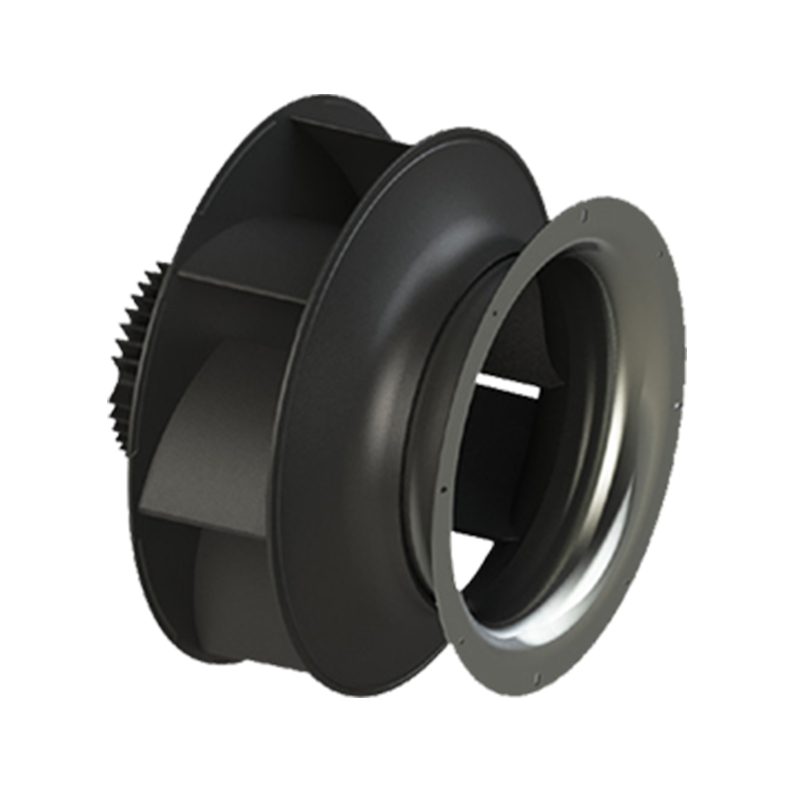
The operating principle of a centrifugal fan is based on the conversion of rotational kinetic energy into pressure energy. The impeller, which rotates at speeds typically between 1,000 and 3,000 revolutions per minute in standard commercial models, draws air into the center of the wheel through an axial inlet. As the impeller vanes accelerate the air radially outward by centrifugal force, the air gains velocity. The volute casing surrounding the impeller then converts this velocity into pressure as the air decelerates through the expanding cross section of the scroll, directing the pressurized airflow to the discharge outlet at 90 degrees from the inlet direction.
The key performance advantage of centrifugal fans over axial fans is their ability to maintain airflow against significant static resistance. A typical wall mounted centrifugal fan in the 200 to 315 mm diameter range can maintain rated airflow against external static pressures of 50 to 300 Pascals, compared to 5 to 30 Pascals for an equivalent axial fan at the same diameter and power input. This pressure generating capability is what makes centrifugal fans essential for any ventilation system that involves duct runs, bends, filters, silencers, or grilles that create resistance to airflow.
Impeller Types and Their Effect on Performance
Wall mounted centrifugal fans are produced with three impeller blade geometries, each suited to different performance and application requirements:
- Forward curved blades: Blades that curve in the direction of rotation. Forward curved impellers achieve maximum airflow at relatively low speeds and low noise levels, making them the preferred choice for building ventilation, air handling units, and any application where quiet operation in occupied spaces is important. Their limitation is reduced efficiency at high static pressures.
- Backward curved blades: Blades that curve against the direction of rotation. Backward curved impellers are more efficient than forward curved designs at higher static pressures, have a non overloading power characteristic (motor power does not increase as the operating point moves toward free delivery), and are the standard choice for high performance HVAC systems and industrial process ventilation where operating efficiency and stable performance across varying load conditions are priorities.
- Radial blades: Straight blades extending directly from the hub. Radial blade impellers are the most robust design and the most resistant to fouling from particulate matter in the airstream, making them the correct choice for industrial extract systems handling dusty, fibrous, or contaminated air where other blade designs would accumulate deposits that alter their performance and balance over time.
Key Applications for Wall Mounted Centrifugal Fans
The pressure capability and compact installation profile of wall mounted centrifugal fans make them suitable for a wider range of applications than any other single fan type. The following sectors represent the most common and commercially significant applications:
- Commercial kitchen extraction: Kitchen canopies and extract hoods require fans capable of overcoming the static resistance of grease filters, duct runs, and external weather grilles while handling air contaminated with grease vapor and elevated temperatures. Wall mounted centrifugal fans with stainless steel or powder coated casings and motor thermal protection are the standard specification for commercial kitchen extract systems.
- Building general ventilation (MEV and MVHR): Mechanical extract ventilation (MEV) systems in residential and commercial buildings use wall mounted centrifugal fans to continuously extract air from wet rooms, kitchens, and utility spaces through a network of ducts. The fan must operate reliably and quietly at low to medium static pressure continuously, which suits the low noise and reliable continuous duty characteristics of quality centrifugal fan designs.
- Industrial workshops and process ventilation: Manufacturing environments generate heat, solvent vapors, welding fumes, and airborne particulates that must be extracted continuously to maintain safe working conditions. Wall mounted centrifugal fans in industrial grade casings with ATEX rated options for potentially explosive atmospheres serve this sector.
- Server rooms and data centers: Equipment rooms containing servers, UPS systems, and network hardware generate significant heat loads that require reliable mechanical ventilation at controlled airflow rates. Wall mounted centrifugal fans with variable speed drives allow airflow to be modulated in response to temperature sensors, providing energy efficient cooling that adapts to varying equipment loads.
- Car parks and underground garages: Car park ventilation systems require fans capable of handling exhaust gases and particulates while operating in challenging environments with temperature extremes and moisture. Jet fans and centrifugal extract fans are both used in this sector, with wall mounted centrifugal models serving smaller single level installations and those without dedicated fan rooms.
Selecting the Right Wall Mounted Centrifugal Fan: Key Specifications
Correct fan selection requires matching the fan's performance characteristics to the specific requirements of the ventilation system. The following parameters must be defined before a fan can be correctly specified:
Airflow Rate and Static Pressure
The required airflow rate in cubic meters per hour (m3/h) is calculated from the volume of the space to be ventilated multiplied by the required number of air changes per hour, or from the heat load to be removed divided by the temperature differential the ventilation system must achieve. The available external static pressure is the sum of all resistance to airflow in the system, calculated from duct length and diameter, the number and type of bends, the resistance of any filters or heat exchangers, and the pressure drop across grilles and louvres at inlet and outlet. The fan must be selected at a duty point on its performance curve where it delivers the required airflow at a static pressure equal to or greater than the calculated system resistance. Operating a fan at a duty point away from its design point, particularly at much lower static pressure than its rated pressure, leads to excessive noise and potential motor overload.
Motor Power and Electrical Supply
Wall mounted centrifugal fans are available in single phase (230V, 50Hz) and three phase (400V, 50Hz) motor versions, covering power ranges from below 100 watts for small residential extract fans to several kilowatts for large industrial models. Single phase models are appropriate for residential, light commercial, and small commercial applications where three phase supply is unavailable. Three phase models offer higher efficiency, better starting characteristics, and longer motor life for continuous duty industrial applications. Many modern wall mounted centrifugal fans are available with EC (electronically commutated) motors that provide variable speed control and significantly higher electrical efficiency than traditional AC induction motors.
Noise Level and Occupied Space Requirements
Noise is one of the most commonly underspecified parameters in ventilation fan selection, and it is one of the most frequent sources of complaint and system replacement after installation. Fan noise is expressed in decibels (dB) measured at a standard distance (typically 1 or 3 meters from the inlet or outlet), and the relevant standard measurement conditions should be stated when comparing fans from different manufacturers. For occupied spaces including offices, bedrooms, consultation rooms, and classrooms, sound pressure levels above 35 to 40 dB(A) at the listener's position are generally considered intrusive. Fans for these applications should be selected with the lowest available sound power level at the duty point, and acoustic lining in associated ductwork should be considered to attenuate fan noise transmitted through the duct system.
IP Rating for Environmental Protection
The IP rating defines the degree of protection the fan enclosure provides against the ingress of solid particles and liquids. For wall mounted centrifugal fans:
- IP44: Protection against solid objects above 1 mm and water splashing from any direction. Minimum rating for bathroom and kitchen environments where the fan may be exposed to water spray.
- IP54: Dust protection (limited ingress permitted) and water splash protection. Suitable for general industrial environments and outdoor locations with cover.
- IP55: Dust protection and protection against low pressure jets of water from any direction. Required for outdoor installations without weather protection or for wash down environments in food processing facilities.
- IP65 and above: Total dust tight protection and jet water resistance. Specified for demanding outdoor or industrial environments with regular cleaning or high pressure wash down requirements.
Comparing Wall Mounted Centrifugal Fans: Key Performance Parameters
| Fan Size (diameter) |
Typical Airflow Range (m3/h) |
Max Static Pressure (Pa) |
Motor Power Range (W) |
Typical Application |
| 100 mm |
80 to 180 |
Up to 80 |
15 to 35 |
Residential bathroom and toilet extract |
| 150 mm |
250 to 550 |
Up to 120 |
40 to 120 |
Kitchen extract, small commercial rooms |
| 200 mm |
600 to 1,400 |
Up to 200 |
120 to 370 |
Commercial kitchen, office ventilation |
| 250 mm |
1,200 to 3,000 |
Up to 300 |
250 to 750 |
Industrial workshop, server room |
| 315 mm and above |
2,500 to 8,000 and above |
Up to 500 and above |
750 to 5,500 |
Large industrial, car park, process extract |
Table 1: Typical performance parameters for wall mounted centrifugal fans by impeller diameter across common residential, commercial, and industrial size ranges
Installation Considerations for Wall Mounted Centrifugal Fans
Correct installation is as important as correct specification for achieving the ventilation performance and service life that the fan is designed to deliver. Wall mounted centrifugal fans impose structural loads on the mounting wall through both the static weight of the unit and the dynamic forces generated by motor and impeller rotation. The following installation principles apply to most wall mounted centrifugal fan installations:
- Wall structural adequacy: The mounting wall must be capable of supporting the fan weight with an adequate safety factor for dynamic loads. Hollow partition walls and lightweight cladding panels are generally unsuitable for direct mounting of any fan above a few kilograms without a dedicated structural frame or bracket that transfers the load to the building primary structure.
- Anti vibration mounting: All centrifugal fans transmit some vibration to the building structure through their mounting points, which can cause noise transmission to adjacent occupied spaces and accelerate fatigue of mounting hardware over time. Anti vibration mounts (rubber or spring isolators) between the fan base and the wall mounting surface significantly reduce transmitted vibration and should be specified for any fan installed in or adjacent to occupied spaces.
- Duct connection flexibility: The duct connections at fan inlet and outlet should incorporate flexible sections (typically rubber or canvas flexible duct connectors) that prevent duct borne vibration transmission and accommodate the small positional differences between the fan flanges and the installed ductwork. Rigid duct connections directly to the fan flanges without flexible sections are a common source of vibration induced noise and premature duct joint failure.
- Electrical connection and motor protection: The electrical supply to the fan motor must be correctly sized for the motor's full load current, starting current, and protection requirements. Motor overload protection (either integral thermal overload in the motor or an external overload relay in the control panel) must be set to the correct trip current for the specific motor to prevent thermal damage from sustained overload or single phase failure in three phase applications.
- Maintenance access: Wall mounted centrifugal fans require periodic maintenance including impeller and casing cleaning, bearing inspection, and motor lubrication where specified. The installation location and mounting arrangement must provide sufficient access space for a technician to perform these tasks without removing the entire fan from the wall. A minimum clearance of 600 mm in front of the fan access panel is a practical working requirement for most commercial fan sizes.
A wall mounted centrifugal fan correctly specified for the airflow and static pressure requirements of the application, installed with proper structural support, vibration isolation, and flexible duct connections, and maintained at the manufacturer's recommended service intervals will reliably deliver its design performance for a service life of 15 to 25 years in standard commercial and industrial applications. The investment in correct initial specification and professional installation consistently delivers a better outcome over the life of the system than selecting the lowest cost unit without evaluating its suitability for the specific duty conditions of the installation.



 English
 中文简体
中文简体 русский
 Español




 OEM/ODM HVAC Axial Fan Manufacturers
