


 English
 中文简体
中文简体 русский
 Español
News
How to choose the centrifugal fan that suits you best?
Introduction to Centrifugal Fans
What are Centrifugal Fans?
Centrifugal fans, also known as radial fans or blowers, are mechanical devices designed to move air or gas by increasing its velocity and volume using a rotating impeller. They're a key component in a vast range of applications, from home HVAC systems to heavy industrial processes. Unlike axial fans that move air parallel to the impeller's axis, centrifugal fans draw air into the center of the fan and then accelerate it radially outward.
Basic Working Principle
The working principle of a centrifugal fan is based on the conversion of kinetic energy into pressure. Air enters the fan's housing at the intake, which is at the center of the rotating impeller. The impeller, with its blades, spins and forces the air to move outward towards the fan's discharge, which is the outlet. This motion increases the velocity and static pressure of the air. The fan's housing, often a scroll-shaped casing, directs this high-velocity airflow and converts some of the kinetic energy into increased static pressure. This makes centrifugal fans ideal for applications that require moving air against high resistance.
Key Components of a Centrifugal Fan
A typical centrifugal fan is comprised of several key parts that work together to move air effectively. The main components are:
- Impeller (or Fan Wheel): This is the heart of the fan. The impeller is a rotating component with blades or vanes that create the airflow. The design and number of blades significantly impact the fan's performance characteristics, such as airflow, pressure, and efficiency.
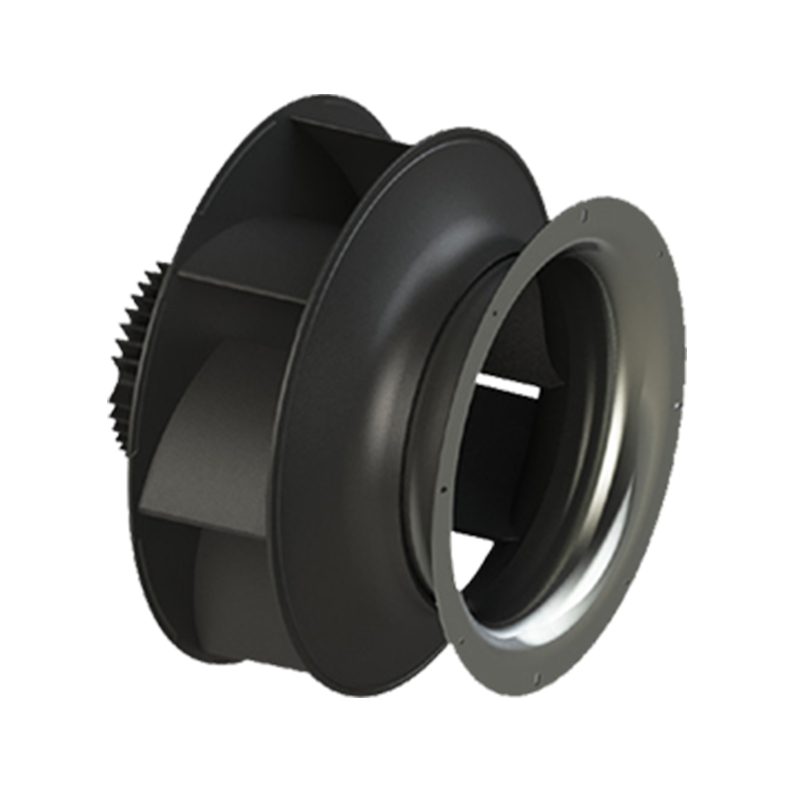
- Housing (or Casing): The housing is a protective enclosure that surrounds the impeller. It channels the air as it exits the impeller and directs it toward the outlet. The shape of the housing, typically a spiral or scroll, helps to convert the air's kinetic energy into static pressure.
- Inlet and Outlet: The inlet is the opening where air enters the fan, usually at the center of the housing. The outlet is the opening through which the processed air exits the fan.
- Drive Mechanism: This includes the motor, shaft, and any belts or pulleys that connect the motor to the impeller, providing the power needed to rotate the impeller at the desired speed.
- Bearings: These are critical components that support the rotating shaft and impeller, reducing friction and ensuring smooth, stable operation.
Types of Centrifugal Fans
Airfoil Fans: High Efficiency and Low Noise
Airfoil fans are known for their exceptional efficiency and low noise output. Their blades are shaped like an airplane wing, allowing for smooth, laminar airflow across their surface. This design minimizes turbulence and drag, which translates to higher energy efficiency and quieter operation compared to other fan types. These fans are typically used in HVAC systems, commercial buildings, and hospitals where efficiency and low noise are critical.
Backward Inclined Fans: Versatile and Efficient
Backward inclined fans have flat, single-thickness blades that are slanted away from the direction of rotation. This design provides high static pressure and high efficiency, though not as high as airfoil fans. They are less prone to dust accumulation on the blades, making them a good choice for handling moderately dirty air streams. Their versatility makes them a popular option for a wide range of applications, including general ventilation, air handling units, and industrial exhaust systems.
Forward Curved Fans: Compact and Cost-Effective
Forward curved fans have blades that curve in the direction of rotation, resembling a squirrel cage. This design produces a large volume of air at a lower pressure and speed. They are smaller and more compact for a given airflow, making them an excellent choice for applications with space constraints, such as residential furnaces and air conditioners. While they are less efficient than backward-inclined or airfoil fans, their smaller size and lower cost make them very popular for low-pressure applications.
Radial Fans: Heavy-Duty and Durable
Radial fans have straight, radial blades, much like a paddle wheel. This simple, robust design is highly resistant to dust and particulate buildup, making them ideal for handling heavy, dirty air or material conveying applications. They can generate very high static pressure, but their efficiency is generally lower and they can be noisier than other fan types. Radial fans are commonly used in dust collection systems, pneumatic conveying, and for moving materials like wood chips or grain.
Inline Centrifugal Fans: Space-Saving Design
Inline centrifugal fans combine the benefits of centrifugal airflow with a space-saving, in-line design. Unlike a traditional centrifugal fan that has a perpendicular air inlet and outlet, an inline centrifugal fan's inlet and outlet are on the same axis. This allows it to be installed directly within a ductwork system, making it an excellent choice for applications where space is limited. They are commonly used in exhaust systems for bathrooms, kitchens, and commercial buildings.
| Parameter | Airfoil Fans | Backward Inclined Fans | Forward Curved Fans | Radial Fans |
|---|---|---|---|---|
| Efficiency | Highest | High | Low | Low |
| Noise Level | Lowest | Low | Medium | High |
| Pressure | Medium-High | Medium-High | Low | Highest |
| Blade Design | Wing-shaped | Flat, curved away from rotation | Curved in direction of rotation | Straight, paddle-like |
| Best Use | Clean air, high efficiency | General purpose, moderately dirty air | Low-pressure, compact systems | Heavy-duty, dirty air, material handling |
Applications of Centrifugal Fans
HVAC Systems: Heating, Ventilation, and Air Conditioning
Centrifugal fans are the backbone of many HVAC (Heating, Ventilation, and Air Conditioning) systems. Their ability to generate high static pressure allows them to effectively move large volumes of air through extensive ductwork systems and past components like filters and coils. They are used to supply conditioned air to a building's interior, remove stale air, and circulate air within rooms. In a typical air handling unit, a centrifugal fan pulls in air, pushes it over heating or cooling coils, and then distributes it throughout the building's zones.
Industrial Processes: Air Supply, Exhaust, and Drying
In industrial settings, centrifugal fans are essential for a wide range of processes. They are used to provide air supply for combustion in burners and furnaces, or to cool down machinery and products. They also serve as powerful exhaust fans, removing harmful fumes, vapors, and hot air from work areas to ensure a safe environment. Additionally, their ability to deliver a consistent, high-velocity airflow makes them ideal for drying processes in manufacturing, such as drying paint, coatings, or other materials.
Dust Collection Systems: Removing Particulates
Centrifugal fans are a critical component of dust collection systems. Their robust design, particularly radial fans, makes them well-suited for handling air streams that contain a high concentration of dust, wood chips, sawdust, or other particulates. The fan creates the suction necessary to draw the contaminated air into the system, where it is then passed through filters to separate the particulates before the clean air is exhausted.
Material Conveying: Moving Granular Materials
Centrifugal fans are utilized in pneumatic conveying systems to move granular materials, powders, and pellets. The fan generates the necessary airflow and pressure to push or pull the material through a pipeline from one location to another. This application is common in industries such as agriculture for moving grain, in food processing for transferring ingredients, and in plastics manufacturing for handling pellets.
Cleanroom Applications: Maintaining Air Quality
In cleanroom applications, centrifugal fans are used to maintain a highly controlled environment with a specific level of cleanliness. They are employed in Fan Filter Units (FFUs) and Air Handling Units (AHUs) to circulate air through HEPA (High-Efficiency Particulate Air) or ULPA (Ultra-Low Penetration Air) filters. The fans work to create positive pressure within the cleanroom, which prevents unfiltered air from entering the space when doors are opened, thereby protecting sensitive processes from contamination.
Key Factors for Selecting a Centrifugal Fan
Choosing the right centrifugal fan is crucial for the efficiency and success of any ventilation system. The selection process should be systematic, considering several critical factors to ensure the fan meets the specific needs of the application.
Airflow and Pressure Requirements
The most fundamental step in fan selection is determining the required airflow ($CFM$) and static pressure ($Pa$ or $in.wg$). Airflow is the volume of air the fan must move over a given period, while static pressure is the resistance the fan must overcome to move that air through ductwork, filters, and other components. These two parameters are typically specified by the system design and are the primary coordinates on a fan's performance curve. A fan's performance is often shown as a curve plotting pressure against airflow.
Fan Efficiency and Energy Consumption
Fan efficiency is a measure of how effectively the fan converts electrical power into airflow and pressure. A higher efficiency rating means less energy is consumed to achieve the desired performance. It is a critical consideration for long-term operational costs and environmental impact. Factors influencing efficiency include the fan type (e.g., airfoil fans are highly efficient), blade design, motor efficiency, and overall system design. Selecting an energy-efficient fan can lead to significant cost savings over its lifetime.
Noise Level Considerations
The noise level produced by a fan is an important factor, especially in applications like commercial buildings, hospitals, and residential areas. Fan noise is typically measured in decibels ($dB$) and is a function of the fan's speed, pressure, and blade design. Forward curved fans are generally quieter at lower pressures, while backward inclined and airfoil fans are the quietest at higher pressures. Proper fan selection and installation (e.g., using silencers, flexible connectors, and vibration isolators) are essential for noise control.
Environmental Conditions and Material Compatibility
The fan's construction material must be compatible with the environment and the fluid (air, gas, or particulate-laden air) it is moving. For corrosive environments, fans made from stainless steel, fiberglass-reinforced plastic (FRP), or with special coatings are necessary. For high-temperature applications, fans with high-temperature bearings and construction are required. When handling abrasive materials like dust or chips, fans with thicker, abrasion-resistant steel blades are used to prevent wear.
Space Limitations and Installation Requirements
The physical size and orientation of the fan must fit within the available space. Inline centrifugal fans are often chosen for ductwork installations where space is a concern, while traditional centrifugal fans with scroll housings may require a larger footprint. The fan's orientation, motor location, and access for maintenance must also be considered during the selection process to ensure a feasible installation.
Advantages and Limitations of Centrifugal Fans
Advantages of Centrifugal Fans
Centrifugal fans show significant advantages in several areas due to their unique design:
- High Static Pressure Capability: Centrifugal fans can produce higher static pressure than axial fans, making them particularly suitable for applications that need to overcome duct resistance or operate in high-pressure environments, such as industrial ventilation, material conveying, and combustion systems. This high static pressure output is a core advantage that distinguishes them from other types of fans.
- Robust Structure and Stable Operation: Due to the design of their impeller and casing, centrifugal fans are generally more robust and durable, able to withstand harsh working conditions, such as handling media containing dust, particles, or corrosive gases. This makes them perform well in heavy industrial applications, with relatively low maintenance costs and a long service life.
- Versatility in Gas Handling: Centrifugal fans can efficiently handle gases of various densities, including high-temperature gases and those containing particulate matter. This versatility makes them indispensable in industrial production lines that require air purification, dust removal, or material conveying.
- High Controllability: By changing the impeller speed or blade angle, centrifugal fans can flexibly adjust airflow and pressure to adapt to different operating conditions. This characteristic makes them very useful in applications requiring precise control of air output.
Limitations of Centrifugal Fans
Despite their significant advantages, centrifugal fans also have some limitations that should be considered when selecting one:
- Relatively Low Efficiency: In certain low-pressure, high-volume applications, centrifugal fans may be less efficient than axial fans. Forward-curved centrifugal fans, in particular, often have lower efficiency than backward-inclined ones.
- Larger Size and Weight: Due to their complex scroll casing and impeller design, centrifugal fans are usually larger and heavier than axial fans of the same airflow capacity. This increases the space required for installation and may make transportation and installation more difficult.
- Higher Noise Levels: The high-speed rotating impeller and the turbulence generated by the airflow inside the scroll casing often result in higher noise levels from centrifugal fans during operation. In applications that require a quiet environment, additional noise reduction measures may be necessary.
Comparison of Performance Parameters for Centrifugal Fan Types
The table below provides a brief comparison of the performance characteristics of the three main types of centrifugal fans (backward-inclined, forward-curved, and radial).
| Characteristic | Backward-inclined Centrifugal Fans | Forward-curved Centrifugal Fans | Radial Centrifugal Fans |
|---|---|---|---|
| Blade Shape | Curved backward | Curved forward | Straight, arranged radially |
| Efficiency | Higher (up to 90%) | Lower (usually below 70%) | Medium |
| Airflow | Larger | Smaller | Medium |
| Static Pressure | High | Medium | Very High |
| Impeller Speed | Higher | Lower | High |
| Suitable Media | Clean gas | Clean gas | Dusty, particulate matter |
| Typical Applications | HVAC systems, industrial ventilation | Residential ventilation, small HVAC | Material conveying, dust removal systems |
Installation and Maintenance Tips
Proper Installation Procedures
Correct installation is critical for a fan's long-term performance and reliability. It's a foundational step that prevents many common issues. The process involves more than just bolting the fan down; it includes checking for damage, ensuring proper alignment, and securing all components. First, the fan must be mounted on a solid, level foundation, often a concrete pad or a substantial steel frame, to prevent vibration and ensure stability. The fan's housing should be securely fastened, and all connecting ductwork should be properly supported to avoid placing stress on the fan casing. Finally, a qualified electrician should handle all wiring, ensuring the motor is correctly connected and rotates in the right direction as indicated by an arrow on the casing.
Regular Inspection and Cleaning
Routine maintenance is essential for preserving a fan's efficiency and lifespan. The most important tasks are regular inspections and cleaning. During an inspection, check for loose bolts, signs of corrosion, and damage to the blades or casing. Cleaning the fan impeller is particularly vital, as dirt, dust, and debris can accumulate on the blades, causing the fan to become imbalanced and leading to increased vibration and reduced airflow. The frequency of cleaning depends on the application; a fan in a dusty environment will need more frequent cleaning than one in a clean air system.
Troubleshooting Common Issues
Understanding common fan problems allows for quick diagnosis and resolution, preventing minor issues from becoming major failures. The most frequent issues include:
- Reduced Airflow: This is often caused by a blockage in the ductwork, a dirty filter, or a buildup of debris on the fan blades.
- Excessive Noise or Vibration: The most common cause is an imbalanced impeller due to uneven dirt buildup or a damaged blade. It can also be a sign of worn bearings, loose mounting bolts, or a misaligned drive system.
- Overheating Motor: This may be a sign of a fan working against too much resistance (high static pressure), insufficient voltage supply, or a dirty motor that can't cool itself properly.
Importance of Balancing and Alignment
Balancing and alignment are paramount for smooth, quiet, and efficient operation. Balancing refers to correcting the mass distribution of the fan impeller to prevent it from vibrating at high speeds. Even a small amount of dirt or a tiny nick on a blade can throw the fan off balance. Alignment ensures that the fan shaft and the motor shaft are perfectly parallel and correctly positioned, especially for belt-driven systems. Misalignment causes excessive stress on the bearings and belts, leading to premature wear and failure. Regular vibration analysis can detect issues early, before they cause catastrophic damage.
Lubrication and Bearing Maintenance
Bearings are one of the most critical components of a centrifugal fan, and their proper maintenance is key to the fan's longevity. They must be lubricated regularly according to the manufacturer's schedule. Using the correct type of lubricant and applying the right amount are both crucial; over-greasing can be just as damaging as under-greasing. You should also regularly inspect the bearings for signs of wear, such as unusual noise or heat. If a bearing is nearing the end of its life, it should be replaced promptly to prevent a catastrophic fan failure.
FAQ
What is the difference between centrifugal fans and axial fans?
The primary difference between centrifugal and axial fans lies in how they move air. Centrifugal fans draw air into the fan inlet and discharge it at a 90-degree angle, or radially, to the fan's axis. This design is best for moving air against high system resistance (high static pressure). Axial fans move air parallel to the fan's axis, similar to a propeller. They are designed for moving large volumes of air at low static pressure.
| Parameter | Centrifugal Fans | Axial Fans |
|---|---|---|
| Airflow Direction | Radial (90° to the fan's axis) | Axial (Parallel to the fan's axis) |
| Pressure Capability | High | Low |
| Typical Air Volume | Medium to High | High |
| Common Applications | HVAC systems, industrial processes, dust collection | Cooling electronics, exhaust fans, general ventilation |
| Design | Impeller with scroll housing | Propeller-like blades |
What are the main types of centrifugal fans?
There are four primary types of centrifugal fans, each with distinct blade designs and performance characteristics.
- Airfoil Fans: Known for the highest efficiency and quietest operation, with wing-shaped blades.
- Backward Inclined Fans: Highly versatile and efficient, with flat blades that curve away from the direction of rotation.
- Forward Curved Fans: Compact and economical, with blades that curve forward in the direction of rotation. They are best for low-pressure, high-volume applications.
- Radial Fans: The most robust and durable type, with straight, paddle-like blades, ideal for handling dirty or abrasive air streams.
What factors affect the performance of centrifugal fans?
A fan's performance is governed by a set of relationships known as the Fan Laws. The key factors are:
- Rotational Speed: The airflow ($CFM$) is directly proportional to the fan speed ($RPM$). The pressure ($Pa$) is proportional to the square of the speed. The power consumption ($kW$) is proportional to the cube of the speed.
- Air Density: The fan's pressure and power consumption are directly proportional to the density of the air it is moving. Changes in altitude, temperature, and humidity all affect air density and, therefore, fan performance.
- System Resistance: The pressure the fan must overcome to move air through the system (ducts, filters, coils) is known as static pressure or system resistance. As system resistance increases, a fan's airflow decreases.
Why do centrifugal fans produce noise? How can it be reduced?
Fan noise originates from two main sources:
- Mechanical Noise: Caused by the motor, bearings, or vibration from an imbalanced impeller.
- Aerodynamic Noise: The dominant source of fan noise, caused by the turbulence of air flowing through the fan's housing and around the blades.
Noise can be reduced by:
- Correct Sizing: Selecting a fan that operates at its peak efficiency point to avoid excessive speed.
- Vibration Isolation: Using flexible connectors and vibration isolators to prevent noise from traveling through the fan's support structure.
- Acoustic Treatment: Installing silencers (mufflers) in the ductwork or using sound-dampening insulation around the fan housing.
- Balancing: Ensuring the impeller is properly balanced to eliminate mechanical noise.
When will a centrifugal fan be overloaded?
A centrifugal fan will be overloaded when the power required to operate it exceeds the motor's capacity. This typically happens when the fan is operating at a lower-than-designed static pressure, causing it to move more air than intended and consume more power. This can be caused by:
- Low System Resistance: For example, if a filter is removed from the ductwork, the system resistance drops, causing the fan to "run away" on its performance curve, increasing airflow and power draw.
- Higher-than-expected Air Density: Moving colder or denser air than the fan was designed for will increase the power required.
How to calculate the air volume and pressure of a centrifugal fan? How to perform routine maintenance on a centrifugal fan?
The air volume and pressure of a centrifugal fan are not calculated but are read from the fan's performance curve. This curve, provided by the manufacturer, shows the relationship between a fan's static pressure and the resulting airflow at a specific speed. To determine the operating point, you must plot the system resistance curve on the fan's performance curve; the intersection of the two curves is the fan's operating point.
Routine maintenance involves several key steps:
- Inspection: Regularly check the fan for signs of wear, corrosion, or damage.
- Cleaning: Periodically clean the fan impeller and housing to remove dirt and debris that can cause imbalance.
- Lubrication: Lubricate bearings according to the manufacturer's schedule and with the correct type and amount of grease.
- Vibration Analysis: Perform periodic vibration analysis to detect and correct imbalance or misalignment issues before they cause damage.
Why do centrifugal fans vibrate? How can this be resolved?
Fan vibration is a common issue that can lead to premature bearing failure and structural damage. The most common causes are:
- Impeller Imbalance: The most frequent cause. It can result from a bent blade, uneven dirt buildup, or a manufacturing defect. This is resolved by balancing the impeller.
- Misalignment: In belt-driven fans, the misalignment of the fan and motor pulleys can cause excessive vibration. This is resolved by properly aligning the shafts and pulleys.
- Worn Bearings: Damaged or worn bearings can cause a rattling or grinding vibration. This is resolved by replacing the bearings.
- Loose Components: Loose mounting bolts or a loose fan pulley can cause vibration. The solution is to tighten all fasteners.
How can the efficiency of a centrifugal fan be improved?
Improving a fan's efficiency can lead to significant energy savings. Methods include:
- Variable Frequency Drives (VFDs): A VFD allows the fan's speed to be adjusted to match the airflow requirements of the system, rather than running at full speed constantly. Since fan power consumption is proportional to the cube of the speed, even a small reduction in speed leads to large energy savings.
- Proper Sizing: Selecting a fan that operates near its peak efficiency point on the performance curve is crucial. A fan that is too large or too small for an application will run less efficiently.
- System Optimization: Reducing system resistance by cleaning filters, enlarging ductwork, and minimizing sharp bends allows the fan to move the required airflow with less power.
- Regular Maintenance: A clean, well-lubricated fan with a properly balanced impeller runs more efficiently than one with dirty or misaligned components.
Conclusion
Summarizing the Benefits of Centrifugal Fans
Centrifugal fans are indispensable components in modern ventilation and process systems due to their unique benefits. They excel at moving air against high static pressure, making them suitable for complex ducted systems. Their versatility, high efficiency (in certain types), and durability allow them to be adapted for everything from clean air HVAC to heavy industrial material conveying. The right fan, properly selected and maintained, provides a reliable and energy-efficient solution for a wide array of air-moving applications.
Future Trends in Centrifugal Fan Technology
The future of centrifugal fans is focused on innovation driven by the need for greater efficiency and smart operation. Key trends include:
- Integration of Smart Technology: Fans with integrated sensors and controls will allow for real-time monitoring and automated adjustments to optimize performance and predict maintenance needs.
- Advanced Materials: The use of lighter, stronger, and more corrosion-resistant materials, such as composites and advanced alloys, will improve fan durability and reduce energy consumption.
- Enhanced Aerodynamics: Ongoing research into blade and housing design will continue to push the boundaries of efficiency, further reducing energy consumption and noise levels for the same performance output.
Recommended Products
The variety of models, to meet the development needs of various regions in the world.



Recommended News
CONTACT US

QUICK LINKS
CONTACT INFORMATION
- Email: [email protected]
- Tel: +86-575-86287301
- FAX: +86-0575-86287300
- Address: Provincial High-tech Industrial Park, Xinchang County, Zhejiang Province, China.
© 2025 Zhejiang Kemao Holding Group Co., Ltd.
All Rights Reserved.
 OEM/ODM HVAC Axial Fan Manufacturers
