


 English
 中文简体
中文简体 русский
 Español
News
How Are Axial Fans Used in Industrial and Refrigeration Systems?
Axial vs Centrifugal and Which Fan Type You Actually Need
An Axial Fan is better than a centrifugal fan when the application requires moving large volumes of air at low pressure across a compact, inline installation, and when energy efficiency at high flow rates is the primary operational priority. A centrifugal fan is better when the system demands high static pressure to overcome significant duct resistance, when airflow must be redirected at a right angle to the inlet, or when the application involves moving dense, particulate-laden, or corrosive air streams that would damage exposed axial blade geometries.
For Cold chain and Refrigeration fan applications, the Axial Fan is almost universally the correct choice. Cold chain refrigeration systems from small supermarket display cases to large blast freezers and cold store evaporators rely on the Cold Chain Refrigeration Axial Fan because its high airflow-to-motor-size ratio, compact axial profile, and low energy consumption per cubic meter of air moved reduce both capital cost and the ongoing electrical energy cost that represents the largest operating expense in any refrigerated logistics operation.
Another name for an axial fan is a propeller fan, a term that emphasizes the visual and mechanical similarity between the fan blade assembly and an aircraft or marine propeller. In duct-mounted configurations, it is also called a tube axial fan or vane axial fan depending on the presence of guide vanes. The term Industrial Axial Fan specifically refers to fan units built for continuous duty in industrial environments including cold stores, food processing plants, HVAC systems, power stations, and data centers.
What Is an Axial Fan: Definition, Airflow Principle, and Core Characteristics
An Axial Fan is a mechanical device that moves air or other gases by means of a rotating impeller whose blades are pitched at an angle to the rotational plane, causing air to flow in the direction parallel to the axis of rotation rather than radially outward as in a centrifugal fan. The airflow path enters the fan along the rotational axis, passes through the blade sweep zone, and exits along the same axial direction, making the fan geometrically inline with the duct or opening it serves.
The Aerodynamic Principle Behind Axial Fan Performance
Each blade in an Axial Fan acts as a rotating airfoil. As the blade rotates, the angle of attack between the blade chord and the incoming airflow creates a pressure difference: higher pressure on the pressure face (front face) and lower pressure on the suction face (rear face). This pressure differential generates a net force on the blade in the direction of rotation (torque, which the motor must overcome) and in the axial direction (the thrust that accelerates air through the fan).
The efficiency of this airfoil action, and therefore the overall efficiency of the Axial Fan, depends on the blade pitch angle, blade chord length, number of blades, rotational speed, and the tip clearance between the blade tips and the fan casing. High-performance Industrial Axial Fan designs achieve peak total efficiency values of 75% to 90% at their design operating point, which compares favorably with centrifugal fans that typically achieve 70% to 85% peak efficiency. The key advantage of the axial design is that this high efficiency is maintained over a wide range of flow rates, whereas centrifugal fans lose efficiency more rapidly as operating conditions deviate from the design point.
What Is Another Name for an Axial Fan
An Axial Fan is known by several alternative names that reflect its application context or mechanical configuration:
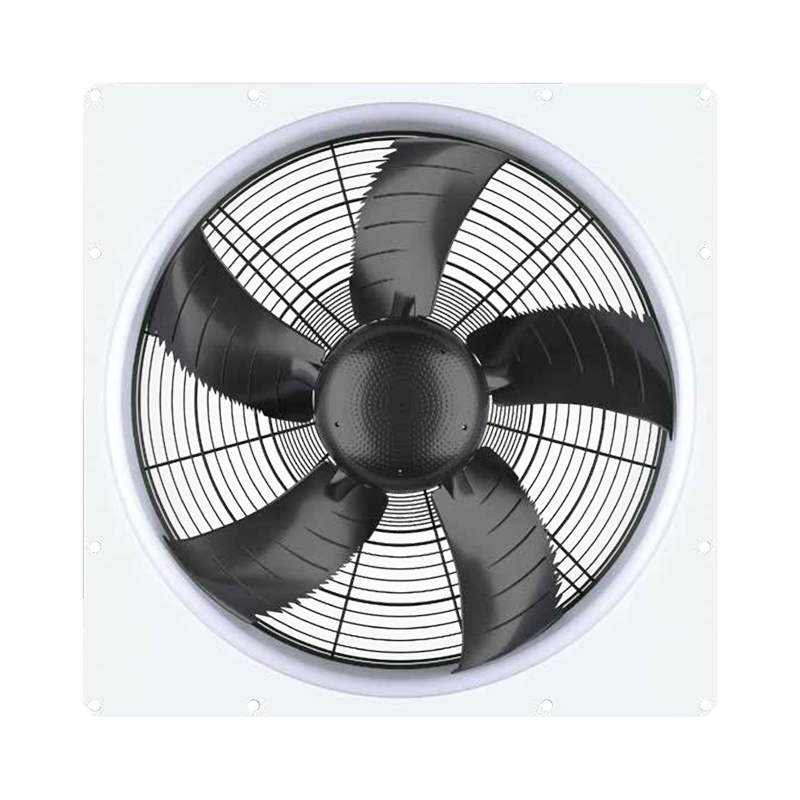
- Propeller fan: The most common general-purpose alternative name, emphasizing the similarity of the blade assembly to a mechanical propeller. Used most frequently for panel-mounted free-delivery fans without a duct casing, particularly in wall-mounted ventilation and equipment cooling applications.
- Tube axial fan: An axial fan mounted inside a close-fitting cylindrical casing (a tube). The tube provides structural mounting for the fan unit, reduces tip vortex leakage back from the high-pressure outlet to the low-pressure inlet, and allows the fan to be installed inline within a duct system without additional transition pieces.
- Vane axial fan: A tube axial fan with the addition of fixed guide vanes (stator vanes) upstream or downstream of the rotating impeller. The guide vanes recover the rotational component of kinetic energy in the airflow that would otherwise be lost, improving the fan's static pressure capability and overall efficiency. Vane axial fans are used in higher-pressure duct systems where tube axial fans would have insufficient pressure capability.
- Plate fan or panel fan: A simple disc-mounted propeller fan fitted directly to a panel, wall, or equipment housing, without a casing. Common in low-cost ventilation and equipment cooling applications where installation simplicity is more important than aerodynamic optimization.
- Through-flow fan (or cross-flow fan): This term is sometimes confused with axial fan but refers to a completely different impeller geometry. True cross-flow fans move air perpendicular to the rotational axis and are not axial fans.
What Are the Three Common Types of Axial Fans
The question of what are the three common types of axial fans is answered by the fan engineering community with reference to the mechanical configuration that determines each type's pressure capability, efficiency profile, and installation requirements. The three types are the propeller (panel) fan, the tube axial fan, and the vane axial fan, arranged in order of increasing pressure capability and aerodynamic sophistication.
Type 1: Propeller Fan (Panel-Mounted Free-Delivery Fan)
The propeller fan is the simplest axial fan type: a rotating impeller mounted on a motor shaft with or without a simple ring guard, installed directly in a panel, wall opening, or equipment enclosure. There is no duct casing to contain the flow, so the air enters and exits the fan impeller at atmospheric pressure on both sides, with the pressure rise generated by the fan used entirely to overcome the minor resistance of the guard, panel opening, and any screen or filter on the inlet face.
Propeller fans deliver high airflow volumes at very low static pressures (typically 0 to 25 Pa), making them appropriate for free-delivery ventilation, equipment panel cooling, condenser and evaporator cooling in refrigeration equipment, and process air circulation where there is no duct resistance to overcome. The Cold Chain Refrigeration Axial Fan used on supermarket display case evaporators and cold room unit coolers is in most cases a propeller fan configuration, because the short air path from fan inlet through the finned evaporator coil to the discharge represents a system resistance of typically 20 to 60 Pa, which is well within the propeller fan's capability.
Type 2: Tube Axial Fan (Ducted Inline Fan)
The tube axial fan is a propeller fan mounted inside a close-fitting cylindrical casing. The casing serves multiple functions: it provides a structural mounting for the fan unit, reduces tip vortex recirculation by minimizing the clearance between the blade tips and the casing wall, and allows the fan to develop moderate static pressure (typically 50 to 500 Pa) by containing the flow rather than allowing it to spread radially in free delivery.
The tube axial fan is the dominant fan type in industrial ventilation duct systems, smoke extraction systems, marine ventilation, and tunnel ventilation where the fan must be installed inline within a duct and must develop enough pressure to overcome the resistance of long duct runs, bends, and terminal grilles. Industrial Axial Fan products in the medium-pressure category (50 to 500 Pa system resistance) are almost exclusively tube axial configurations.
Type 3: Vane Axial Fan (High-Efficiency Pressure Fan)
The vane axial fan adds a set of fixed stator vanes to the tube axial configuration. These vanes may be positioned upstream of the impeller (inlet guide vanes that pre-swirl the incoming air to optimize the blade angle of attack), downstream of the impeller (outlet guide vanes that straighten the swirling outlet airflow and convert its rotational kinetic energy to static pressure), or both. The addition of outlet guide vanes can improve static pressure recovery by 15% to 25% compared to an equivalent tube axial fan without vanes.
Vane axial fans are used in the highest-pressure duct applications within the axial fan family: pressure ranges of 500 to 2,000 Pa that overlap significantly with the operating range of backward-curved centrifugal fans. In these applications, the vane axial fan offers the advantage of inline installation geometry that avoids the right-angle inlet-to-outlet transition required by centrifugal fans, simplifying duct layout and reducing installation cost in many building services and industrial ventilation applications.
| Type | Casing | Guide Vanes | Static Pressure Range | Typical Application |
|---|---|---|---|---|
| Propeller (panel) fan | None or ring only | None | 0 to 25 Pa | Refrigeration evaporators, wall ventilation, panel cooling |
| Tube axial fan | Close-fitting cylinder | None | 50 to 500 Pa | Industrial ventilation ducts, smoke extraction, marine |
| Vane axial fan | Close-fitting cylinder | Inlet and/or outlet | 500 to 2,000 Pa | High-pressure duct systems, HVAC AHUs, tunnel ventilation |
What Is an Advantage of Using an Axial Fan: The Key Benefits Explained
The advantages of an Axial Fan are most clearly understood by comparison with the centrifugal fan, which is the primary alternative for most industrial and commercial air movement applications. Each advantage is most pronounced in specific applications, and understanding which advantages matter most for a given application helps explain why the Cold Chain Refrigeration Axial Fan dominates refrigeration, while centrifugal fans dominate high-resistance duct systems.
Advantage 1: Superior Airflow Volume per Unit of Motor Power
The most universally recognized advantage of using an Axial Fan is its ability to move large volumes of air with relatively low motor power. Because the axial fan's impeller transfers kinetic energy to the air primarily in the axial direction, it can achieve high volumetric flow rates with blade designs that minimize the energy wasted in turbulence and recirculation. A 500mm diameter Industrial Axial Fan with a 0.75 kW motor can deliver 3,000 to 5,000 m3/h of airflow at low static pressures, whereas a centrifugal fan with the same motor power at the same pressure would typically deliver 1,500 to 2,500 m3/h. This 2:1 or better airflow advantage for the same motor power is the primary reason why refrigeration, HVAC, and industrial ventilation engineers specify axial fans wherever the system static pressure is below approximately 500 Pa.
Advantage 2: Compact Inline Installation Without Direction Changes
An Axial Fan maintains the same airflow direction at inlet and outlet, enabling inline installation within straight duct runs without any transition piece, bend, or direction change in the duct system. A centrifugal fan takes air in at the center (axially) and discharges it at 90 degrees (radially), requiring a right-angle transition in the duct system that adds installation cost, increases system resistance, and occupies additional building or equipment space. In refrigeration unit coolers, where the Cold Chain Refrigeration Axial Fan must be mounted within a compact assembly of evaporator coil, casing, and air distribution baffles, the inline geometry of the axial fan is not just an advantage but a geometric necessity.
Advantage 3: Lower Noise at Equivalent Flow Rates
Axial fans typically generate lower aerodynamic noise than centrifugal fans at equivalent flow rates because the air velocity through the blade sweep zone is more uniform and the pressure gradients are gentler. A well-designed Cold Chain Refrigeration Axial Fan operating at its design point produces sound power levels of 35 to 55 dB(A), which is acceptable in retail food environments and cold store facilities where employee comfort and customer experience are considerations. Centrifugal fans at equivalent flow rates in similar refrigeration applications would typically generate 5 to 15 dB(A) higher sound power, which would be commercially unacceptable in most food retail installations.
Advantage 4: Lower Manufacturing Cost and Simpler Maintenance
The impeller of an Axial Fan is mechanically simpler than the scroll-and-impeller assembly of a centrifugal fan, requiring fewer precision-machined components and less material. This translates to lower manufacturing cost for equivalent airflow capacity and simpler field maintenance because there are fewer components to inspect, adjust, or replace. The Cold Chain Refrigeration Axial Fan typically mounts directly on the motor shaft in a direct-drive configuration with no belt, pulley, or gearbox between motor and impeller, eliminating the belt replacement, pulley alignment, and tension adjustment maintenance tasks associated with belt-drive centrifugal fans.
Advantage 5: Reversible Airflow for Defrost Applications
An Axial Fan can reverse its airflow direction simply by reversing its motor rotation direction, without any modification to the fan or duct system. This reversibility is a significant practical advantage in Cold chain and Refrigeration fan applications where controlled reverse airflow is used in hot-gas defrost cycles to melt frost accumulation from the evaporator coil surface. Centrifugal fans cannot effectively reverse airflow direction by reversing motor rotation, because the scroll casing geometry is designed for a single rotation direction only.
Which Is Better, an Axial or Centrifugal Fan: A Practical Head-to-Head Comparison
The question of which is better, an axial or centrifugal fan, does not have a universal answer because the correct choice depends entirely on the application's specific combination of required airflow volume, static pressure, installation space, noise requirement, and budget. The following comparison addresses the most practically important evaluation criteria.
Flow Volume vs Pressure: Where Each Fan Type Excels
The fundamental difference between axial and centrifugal fans is their position on the flow-pressure performance curve. Axial fans are high-flow, low-pressure devices. Centrifugal fans are lower-flow, higher-pressure devices. This single characteristic determines the majority of application selection decisions: any application requiring static pressure above approximately 1,000 to 1,500 Pa is almost certainly better served by a centrifugal fan, while any application requiring maximum flow volume at pressures below 500 Pa is almost certainly better served by an Axial Fan.
In the 500 to 1,500 Pa overlap zone, both fan types can deliver acceptable performance, and the selection decision depends on secondary factors including installation geometry (inline vs right-angle), noise sensitivity, energy efficiency at the specific operating point, and the designer's experience and preference. The vane axial fan has expanded the axial fan's competitive pressure range to above 2,000 Pa in some configurations, overlapping significantly with backward-curved centrifugal fans in this zone.
Energy Efficiency at Different Operating Conditions
Both well-designed axial and centrifugal fans can achieve high peak efficiency (75% to 90% total efficiency at the design point). The practical difference is how each type's efficiency varies as the operating point moves away from the design condition. Axial fans maintain relatively good efficiency across a wider range of airflow rates because the blade pitch angle can be adjusted (in variable-pitch designs) to reoptimize the blade angle of attack as the flow rate changes. Centrifugal fans with backward-curved impellers also maintain good part-load efficiency, but their efficiency drops more steeply when operating significantly above the design flow rate.
Axial vs Centrifugal: Complete Decision Comparison
| Criterion | Axial Fan | Centrifugal Fan | Winner |
|---|---|---|---|
| Maximum airflow per kW at low pressure | 4,000 to 8,000 m3/h per kW | 1,500 to 3,000 m3/h per kW | Axial |
| Maximum static pressure | Up to 2,000 Pa (vane axial) | Up to 20,000 Pa and above | Centrifugal |
| Installation geometry | Inline (no direction change) | Right angle (inlet to outlet) | Axial |
| Noise at high flow rates | Lower | Higher | Axial |
| Suitability for particulate air | Lower (blade erosion risk) | Higher (backward-curved) | Centrifugal |
| Airflow reversibility | Yes (motor reversal) | No | Axial |
| Purchase cost at equivalent flow | Lower | Higher | Axial |
| Best application pressure range | 0 to 1,500 Pa | 500 Pa and above | Application dependent |
Industrial Axial Fan: Specifications, Materials, and Operating Requirements
The Industrial Axial Fan category encompasses fan units designed for continuous operation in demanding industrial environments where ambient temperatures, humidity, corrosive atmospheres, and explosive gas risk present challenges that standard commercial fans cannot withstand reliably. Industrial specification fans incorporate design elements and material specifications that distinguish them from commercial HVAC fans of similar size and flow capability.
Key Design Elements of Industrial Axial Fan Products
- Impeller materials: Industrial Axial Fan impellers are manufactured from die-cast aluminum alloy (LM6 or equivalent) for most general industrial applications providing a balance of light weight, corrosion resistance, and dimensional stability under thermal cycling. Glass-fiber reinforced plastic (GRP) impellers are used in corrosive atmosphere applications including chemical process ventilation, marine ventilation, and waste water treatment plant ventilation where aluminum would corrode unacceptably. Stainless steel impellers are specified for food processing, pharmaceutical clean rooms, and hygienic applications where regular washdown with detergent solutions would attack aluminum or GRP.
- Motor protection classes: Industrial Axial Fan motors are specified to minimum IP55 ingress protection rating (protected against dust ingress and water jets from any direction) for general industrial duty, with IP65 or IP67 specified for wash-down environments. Insulation class F (maximum continuous winding temperature 155 degrees Celsius) is the standard for industrial motors, providing adequate thermal margin for operation at elevated ambient temperatures without exceeding the motor's rated temperature limits.
- ATEX certification for explosive atmospheres: Industrial environments where flammable gases, vapors, or combustible dusts may be present require ATEX-certified fan units that are designed and tested to prevent ignition of the surrounding atmosphere. ATEX Industrial Axial Fan units use non-sparking impeller materials (typically GRP or aluminum with stainless steel tips), controlled surface temperatures below the auto-ignition temperature of the gas group, and anti-static electrical bonding to prevent electrostatic charge buildup on non-conductive components.
- Variable pitch impellers: High-performance Industrial Axial Fan products for large HVAC systems and power station cooling towers use variable-pitch impellers where the blade angle can be adjusted while the fan is running. This allows the fan's operating point to be shifted across a wide range of flow rates and pressures without changing motor speed, enabling precise control of airflow to match varying process or ventilation demands. Variable-pitch axial fans achieve energy savings of 30% to 60% compared to fixed-pitch fans controlled by inlet dampers in variable-flow applications.
Industrial Axial Fan Performance Parameters
The key performance parameters that must be specified when selecting an Industrial Axial Fan for any application are:
- Design flow rate (m3/s or m3/h): The volumetric airflow required at the application's operating conditions, including temperature and altitude corrections for air density deviations from the standard conditions at which fan performance data is published (typically 20 degrees Celsius, 1.2 kg/m3 air density, sea level).
- Total static pressure (Pa or mmWG): The sum of all pressure losses in the system including duct friction, bends, grilles, filters, and process equipment resistance that the fan must overcome to deliver the design flow rate. Underestimating system resistance leads to insufficient airflow; overestimating leads to fan selection in an inefficient operating region.
- Blade tip speed and noise level: Blade tip speed (the product of impeller radius and angular velocity) is the primary determinant of fan noise. Industrial Axial Fan designs for noise-sensitive environments limit blade tip speed to below 60 m/s, which corresponds to a sound power level of approximately 75 to 85 dB(A) for typical impeller geometries. High-efficiency, low-noise blade profiles can reduce noise by 3 to 8 dB(A) compared to standard blade geometries at the same tip speed.
Cold Chain and Refrigeration Fan: Why the Axial Fan Dominates This Sector
Cold chain and Refrigeration fan applications represent the largest single market segment for Axial Fan products globally by unit volume. The combination of compact installation geometry, high airflow per unit power, low noise, and airflow reversibility for defrost cycles makes the Axial Fan the natural and commercially dominant choice for virtually every cold chain application from domestic refrigerators to industrial blast freezers.
The Cold Chain Refrigeration Axial Fan in Different Applications
Cold chain and Refrigeration fan applications span a wide range of scales and temperature environments, each with specific Cold Chain Refrigeration Axial Fan requirements:
- Supermarket display cases (0 to plus 8 degrees Celsius): Multi-deck open display cases for fresh food, dairy, and beverages use multiple small-diameter (100 to 200mm) Cold Chain Refrigeration Axial Fan units to circulate air through the finned evaporator coil and across the displayed merchandise. The fans must operate quietly (below 45 dB(A) at 1 meter to comply with retail environment noise standards), efficiently (high COP is commercially critical because display case energy consumption is a significant operational cost for supermarket operators), and reliably for 40,000 to 80,000 hours continuous service between overhauls. EC (electronically commutated) motor technology in the most advanced Cold Chain Refrigeration Axial Fan products reduces motor energy consumption by 50% to 70% compared to shaded-pole AC motors, delivering operating cost savings that pay back the premium price of EC fans within 12 to 24 months in typical supermarket operating conditions.
- Cold store unit coolers (minus 25 to plus 8 degrees Celsius): Walk-in cold stores and large cold warehouses use ceiling-mounted unit coolers, each containing 2 to 8 axial fan units drawing air through the evaporator coil and discharging it horizontally into the cold room. Cold store unit coolers operate at air temperatures down to minus 25 degrees Celsius in blast freezer applications, requiring Cold Chain Refrigeration Axial Fan products with motors rated for continuous operation at these temperatures, frost-resistant blade materials (typically high-density polyethylene or glass-fiber reinforced plastic rather than aluminum, which becomes brittle below minus 20 degrees Celsius), and sealed bearings packed with low-temperature grease that retains viscosity at minus 30 degrees Celsius.
- Refrigerated transport (minus 20 to plus 4 degrees Celsius): Refrigerated truck bodies and shipping containers use compact Cold Chain Refrigeration Axial Fan units in the evaporator and condenser sections of the refrigeration unit mounted at the front of the container or trailer body. The extreme vibration environment of road and sea transport requires fan units with heavy-duty balanced impellers, reinforced motor mounting systems, and anti-vibration rubber mounts between the fan assembly and the refrigeration unit structure to prevent fatigue failure of motor windings and fan blade root attachments.
- Industrial blast freezing tunnels (minus 35 to minus 40 degrees Celsius): Food industry blast freezers use high-velocity axial fans to drive cold air at 3 to 5 m/s over product passing through the tunnel on a conveyor belt. The high air velocity rapidly removes latent heat from the product surface, accelerating the freezing process and reducing product quality degradation from ice crystal growth during slow freezing. Industrial Axial Fan units for blast freezer tunnel duty typically use direct-drive external rotor motors of 1.5 to 15 kW per fan unit, with 400 to 800mm diameter impellers, and are rated for continuous operation at minus 40 degrees Celsius ambient.
EC Motor Technology in Cold Chain Refrigeration Axial Fan Products
The transition from traditional AC induction and shaded-pole motors to electronically commutated (EC) permanent magnet motors is the most significant technical development in Cold chain and Refrigeration fan technology of the past decade. EC motors use a brushless permanent magnet rotor and an electronic commutation system that continuously optimizes the motor's power consumption for the actual operating condition, achieving motor efficiencies of 80% to 92% across the full operating range compared to 20% to 60% for shaded-pole motors and 60% to 80% for standard AC induction motors at partial load.
For a supermarket with 50 display cases each using 4 Cold Chain Refrigeration Axial Fan units of 10 watts each, replacing shaded-pole motors with EC motors achieving double the efficiency at part load conditions delivers an annual electricity saving of approximately USD 3,000 to USD 5,000 per supermarket. Multiplied across a chain of 100 stores, this represents USD 300,000 to USD 500,000 per year in reduced electricity costs, which typically paybacks the higher purchase cost of EC fan units within 18 to 30 months and then continues to generate positive cash flow for the remaining 15 to 20 year service life of the fan units.
Selecting the Right Axial Fan: Key Specification Parameters and Common Mistakes
Selecting the correct Industrial Axial Fan or Cold Chain Refrigeration Axial Fan for a specific application requires accurately defining several interdependent parameters. Errors in any one of these parameters typically result in either insufficient airflow, excessive energy consumption, excessive noise, or premature mechanical failure, all of which impose costs on the system operator that far exceed the purchase price of correctly specified replacement fans.
Common Specification Mistakes and How to Avoid Them
- Neglecting air density corrections: Fan performance data is published at standard conditions (typically 20 degrees Celsius, sea level, 1.2 kg/m3 density). At high altitude (above 1,000 meters) or high temperature (above 40 degrees Celsius), actual air density is significantly lower. At 40 degrees Celsius and 1,000 meters altitude, air density is approximately 1.05 kg/m3, which is 12.5% below the standard 1.2 kg/m3. An Axial Fan delivering the correct airflow volume at reduced air density delivers 12.5% less air mass flow, which may be inadequate for heat exchanger or ventilation applications sized for mass flow rather than volume flow.
- Underestimating system resistance: System resistance typically includes pressure losses in intake screens, filters, heat exchanger cores, distribution grilles, and ductwork that are easy to underestimate at the design stage. A fan selected for 150 Pa that actually faces 250 Pa system resistance will deliver significantly less than the design flow rate, shifting the operating point to the left of the fan curve where efficiency is lower and noise is higher.
- Selecting fan size based on diameter alone: Two Axial Fan products of the same diameter from different manufacturers can have very different performance characteristics depending on blade number, blade pitch, hub-to-tip ratio, and motor speed. Always specify performance using flow rate, static pressure, and efficiency data rather than diameter alone.
- Ignoring stall risk: Axial fans operated significantly to the left of their peak efficiency point (at lower flow rates than designed) can enter aerodynamic stall, where the blade angle of attack becomes too high and the smooth airfoil flow breaks down into turbulent separation. Stall produces dramatically increased noise, vibration, and reduced efficiency, and can cause rapid mechanical failure through blade fatigue. Always verify that the intended operating point falls on the stable portion of the fan curve, to the right of the stall point.
Frequently Asked Questions
1. Which is better, an axial or centrifugal fan, for general industrial ventilation?
For general industrial ventilation applications with system static pressures below 500 Pa, the Axial Fan is better because it delivers more airflow per unit of motor power, installs inline without direction changes, produces lower noise, and costs less at equivalent flow capacity. For applications with static pressures above 1,000 Pa (long duct runs, high-resistance filter systems, process pressurization), the centrifugal fan is better because it develops much higher pressures while maintaining reasonable efficiency. In the 500 to 1,000 Pa overlap range, the selection depends on installation geometry, noise requirements, and the specific performance curves of the candidate fan models.
2. What is an advantage of using an axial fan in refrigeration applications?
The most important advantage of using an Axial Fan in refrigeration applications is its high airflow volume per unit of motor power, which directly reduces the refrigeration system's electrical energy consumption. Additional advantages specific to refrigeration include: compact inline geometry that fits within the space-constrained unit cooler casing; reversible airflow direction by motor reversal for defrost cycle management; low noise suitable for food retail environments; and compatibility with EC motor technology that reduces fan motor energy consumption by 50% to 70% compared to shaded-pole motors, providing significant operating cost savings over the fan's service life.
3. What are the three common types of axial fans and where is each used?
The three common types of axial fans are: the propeller (panel) fan, used in free-delivery applications with very low static pressure including refrigeration evaporators, wall ventilation, and equipment panel cooling (0 to 25 Pa pressure range); the tube axial fan, used in duct-mounted inline ventilation with moderate static pressure including industrial ventilation systems, smoke extraction, and marine ventilation (50 to 500 Pa); and the vane axial fan, which adds guide vanes to increase pressure capability for high-pressure duct applications including large HVAC air handling units and tunnel ventilation (500 to 2,000 Pa).
4. What is another name for an axial fan?
Another name for an axial fan is a propeller fan, which is the most widely used alternative term in general English-language usage. When the fan is mounted inside a cylindrical casing without guide vanes, it is called a tube axial fan. When guide vanes are added to the casing, it is called a vane axial fan. In some regional markets, the term through-flow fan or inline fan is used for duct-mounted axial units. In panel-mounting and equipment cooling applications, plate fan, panel fan, or exhaust fan are commonly used alternatives depending on the installation type.
5. What makes a Cold Chain Refrigeration Axial Fan different from a standard axial fan?
A Cold Chain Refrigeration Axial Fan differs from a standard axial fan in several specification aspects that reflect the specific demands of cold chain operation. The motor is rated for continuous operation at temperatures down to minus 25 degrees Celsius (or minus 40 degrees Celsius for blast freezer duty), using sealed bearings packed with low-temperature synthetic grease that retains viscosity and lubrication at sub-zero temperatures. Impeller materials are frost-resistant (GRP or high-density polyethylene rather than aluminum, which becomes brittle below minus 20 degrees Celsius). The motor winding insulation system is rated for the combination of low temperature and high humidity condensation cycling that occurs during normal refrigerated equipment operation. The fan is designed to be driven in reverse for defrost cycle management, with motor and impeller engineering validated for both rotation directions.
6. How do I calculate the airflow required for a cold store unit cooler?
The airflow required for a cold store unit cooler is calculated from the design refrigeration capacity of the evaporator and the temperature difference between the entering and leaving air across the coil. Using the psychrometric relationship: airflow (m3/s) equals the refrigeration capacity in watts divided by (air density in kg/m3 multiplied by specific heat of air in J/kg·K multiplied by the entering-to-leaving air temperature difference in Kelvin). For a 10 kW unit cooler with a 10 Kelvin temperature split, using air density of 1.3 kg/m3 at the cold store temperature and specific heat of 1,006 J/kg·K: airflow equals 10,000 divided by (1.3 multiplied by 1,006 multiplied by 10), giving approximately 0.76 m3/s or 2,750 m3/h. Select Cold Chain Refrigeration Axial Fan units whose combined flow rate matches or exceeds this calculation at the system static pressure of the unit cooler casing.
7. Can an Industrial Axial Fan be used in explosive atmosphere zones?
Yes, Industrial Axial Fan products with ATEX certification can be used in explosive atmosphere zones classified as Zone 1 (gas/vapor present intermittently in normal operation), Zone 2 (gas/vapor present only in abnormal conditions), Zone 21 (combustible dust present in normal operation), or Zone 22 (combustible dust present only in abnormal conditions). ATEX-certified Industrial Axial Fan units use non-sparking impeller materials, controlled surface temperatures verified to remain below the auto-ignition temperature of the specified gas group, and anti-static electrical bonding. The ATEX marking on the fan nameplate specifies the equipment group, category, type of protection, and gas/dust group for which the fan is certified, and these must be verified as appropriate for the specific hazardous area classification of the installation before use.
8. What is the typical service life of a Cold Chain Refrigeration Axial Fan and how is it maintained?
A quality Cold Chain Refrigeration Axial Fan with sealed ball bearings, EC motor, and appropriately specified impeller material has a design service life of 40,000 to 80,000 hours of continuous operation, equivalent to 5 to 9 years of 24-hour per day continuous service. The primary maintenance requirement is periodic bearing replacement at the manufacturer's recommended interval (typically 30,000 to 50,000 hours for sealed deep groove ball bearings in cold temperature service). The fan and motor assembly should be inspected for ice buildup during the defrost cycle, corrosion of the motor casing and impeller, and any vibration or noise change that would indicate bearing wear, blade erosion, or impeller imbalance. Fan air inlet screens and evaporator coil surfaces should be cleaned on a schedule appropriate to the operating environment to maintain designed system resistance and airflow.
9. How does blade pitch angle affect axial fan performance?
Blade pitch angle is the angle between the blade chord line and the plane of rotation, and it is the most influential single parameter governing the Axial Fan's performance. Increasing pitch angle increases the blade's angle of attack against the incoming airflow, generating more lift force and therefore more pressure rise and torque demand per revolution. Higher pitch angles produce more flow and pressure but require more motor power and are more susceptible to blade stall if the angle exceeds the critical stall angle for the blade profile. Lower pitch angles reduce flow and pressure but require less power and provide a wider stall-free operating range. Variable-pitch Industrial Axial Fan designs exploit this relationship by adjusting blade angle in real time to match the fan's output to system demand, enabling energy savings of 30% to 60% in variable-flow applications compared to fixed-pitch fans controlled by throttling.
10. What noise levels should be expected from an Axial Fan in a cold store application?
Sound pressure levels from Cold Chain Refrigeration Axial Fan units in cold store applications typically range from 35 to 55 dB(A) measured at 1 meter from the fan face, depending on fan diameter, rotational speed, and system static pressure. In operator-access cold stores (walk-in stores, pick-and-pack areas), occupational noise exposure regulations require that combined sound levels from all unit coolers and other equipment remain below 80 dB(A) at operator positions for extended work periods. For cold stores where personnel work continuously (distribution centers, large cold warehouses), specification of EC-motor Cold Chain Refrigeration Axial Fan products at reduced operating speeds during occupancy hours, enabled by the EC motor's variable speed capability without additional frequency inverter investment, can reduce sound levels by 6 to 12 dB(A) from maximum speed levels, keeping operator noise exposure within regulatory limits.
Recommended Products
The variety of models, to meet the development needs of various regions in the world.



Recommended News
CONTACT US

QUICK LINKS
CONTACT INFORMATION
- Email: [email protected]
- Tel: +86-575-86287301
- FAX: +86-0575-86287300
- Address: Provincial High-tech Industrial Park, Xinchang County, Zhejiang Province, China.
© 2025 Zhejiang Kemao Holding Group Co., Ltd.
All Rights Reserved.
 OEM/ODM HVAC Axial Fan Manufacturers
