

 English
 中文简体
中文简体 русский
 Español
News
Home / News / Industry News / What Is a Centrifugal Fan and How Does It Work? A Complete Guide to Types, Uses, and Selection
A centrifugal fan is a mechanical device that uses a rotating impeller to accelerate air radially outward from the inlet axis, converting kinetic energy into static pressure through the volute casing that surrounds the impeller. It moves air at right angles to the impeller inlet direction, making it fundamentally different from an axial fan that moves air parallel to the rotation axis. Centrifugal fans are the correct choice whenever the system requires high static pressure to overcome duct resistance, filters, coils, or other system impedance that would stall an axial fan operating at the same airflow volume.
Centrifugal fans and blowers are the dominant air-moving technology in HVAC air handling units, industrial process ventilation, dust collection systems, pneumatic conveying, combustion air supply, and any application where the system resistance exceeds approximately 500 to 1,000 Pa (2 to 4 inches water gauge). Axial fans handle the low-pressure, high-flow applications; centrifugal fans handle the high-pressure, moderate-to-high-flow demands.
Centrifugal fan price varies from under USD 50 for small residential inline units to over USD 50,000 for large industrial process fans, with the price primarily driven by airflow volume, static pressure requirement, impeller diameter, material specification, and motor size. The centrifugal fan inline configuration is the most compact and installation-friendly format, suited to duct systems where space constraints prevent the use of a conventional volute-casing fan mounted externally to the duct.
Understanding how does a centrifugal fan work at both the mechanical and aerodynamic level helps engineers select the correct fan for specific system requirements and troubleshoot performance problems when fans do not deliver the expected airflow or pressure.
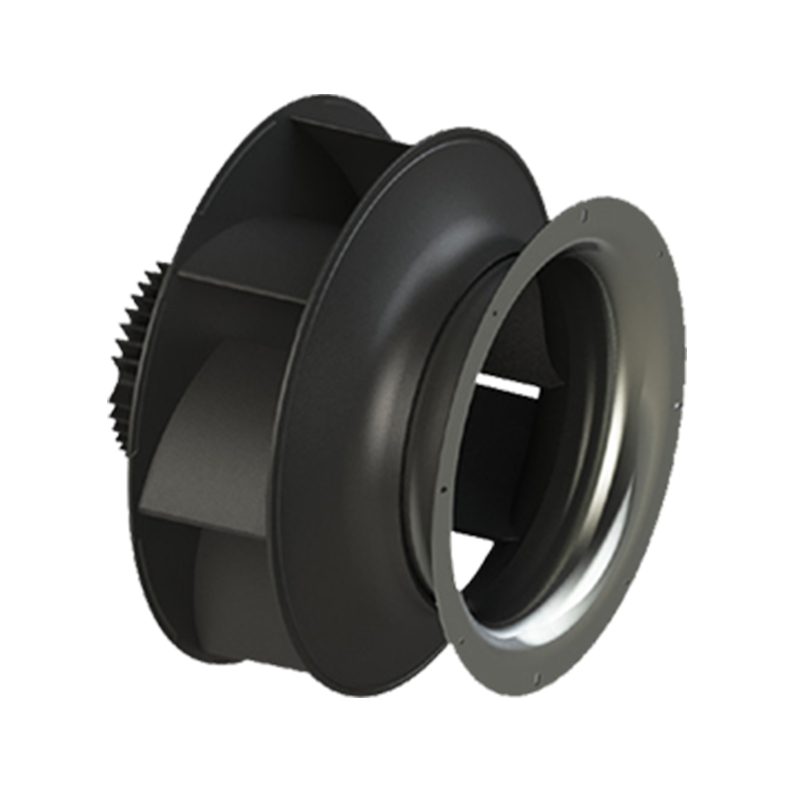
At the heart of how does a centrifugal fan work is the rotating impeller: a set of blades (typically 6 to 12) mounted on a hub that is attached to the motor shaft. When the impeller rotates, the blades push the air contained between them outward from the center (the eye of the impeller) toward the outer edge (the impeller tip). This outward movement is driven by centrifugal force, the tendency of rotating objects to move away from the axis of rotation.
As air is thrown outward from the impeller tip, it enters the volute casing, a spiral-shaped housing that surrounds the impeller. The volute's cross-sectional area increases progressively around the impeller circumference, which converts the high-velocity air from the impeller tip into static pressure through the diffusion principle: as the air slows in the expanding volute, its kinetic energy converts to pressure energy. This conversion of velocity to pressure is the fundamental mechanism by which centrifugal fans achieve higher static pressures than axial fans of similar size and speed.
The complete energy transfer sequence in how does a centrifugal fan work involves three consecutive stages:
The overall efficiency of this conversion sequence (total input electrical power to useful airflow power delivered to the system) is called the fan total efficiency and ranges from 55% to 85% for well-designed centrifugal fans operating at their design point. Peak fan efficiency typically occurs at the fan's design duty point, which is why selecting a fan with its design point close to the actual operating condition produces the lowest energy consumption per unit of airflow.
The centrifugal fan affinity laws describe how airflow, pressure, and power change when fan speed or fan size changes. These laws are essential for how does a centrifugal fan work in variable-speed applications:
Centrifugal fan types are primarily classified by the shape and orientation of the impeller blades, which determines the fan's pressure-flow characteristic curve, efficiency profile, noise level, and suitability for different air stream conditions. Understanding the main centrifugal fan types prevents the common mistake of selecting a fan that is efficient at laboratory test conditions but poorly matched to the actual system.
Forward curved centrifugal fans have blades that curve in the direction of rotation. They are compact for a given airflow volume, run at lower speeds than equivalent backward-curved designs, and produce low noise levels at typical HVAC duct pressures. Forward curved centrifugal fans are the most common centrifugal fan type in residential and light commercial HVAC equipment including fan coil units, unit heaters, and packaged air conditioning units, where their compact size and low noise are commercially valuable. The limitation is that forward curved fans tend to overload their motor as system resistance decreases below the design point, because their power consumption rises steeply toward the open-inlet condition. This overloading behavior means that forward curved fans must be carefully matched to their system and cannot be driven by a VSD that reduces speed below approximately 60% of design speed without risk of motor overload.
Backward curved centrifugal fans have blades that curve against the direction of rotation. They are more efficient than forward curved designs (peak total efficiency 75% to 85% versus 55% to 70% for forward curved), have a non-overloading power characteristic (power consumption peaks at the design point and decreases at higher airflows rather than continuing to rise), and can be safely driven by VSDs across a wide speed range without motor overload risk. Backward inclined fans have straight blades angled backward rather than curved, providing slightly lower efficiency than backward curved but simpler manufacturing and lower cost. Backward curved and backward inclined centrifugal fan types are the preferred specification for high-efficiency air handling units, industrial ventilation, and any VSD-controlled application where energy efficiency is a priority.
Airfoil centrifugal fans are the highest-efficiency centrifugal fan type, using hollow or solid blades with an aerodynamic airfoil cross-section (similar to a wing profile) that generates lift force to move air with less turbulence and lower noise than simple curved blade designs. Peak efficiencies of 80% to 87% total efficiency are achievable with good airfoil impeller designs. Airfoil centrifugal fans are specified for large central air handling units, industrial process ventilation where energy cost dominates the life-cycle economics, and applications where fan noise is a critical constraint. They are more expensive to manufacture than forward or backward curved impellers and are susceptible to erosion and contamination damage in dusty or particulate-laden air streams because the hollow blades can accumulate and be damaged by particulate.
Radial blade centrifugal fans have straight blades oriented radially from the hub to the tip. They are the simplest and most robust of the centrifugal fan types, with lower efficiency than curved or airfoil designs but superior resistance to particulate erosion and material buildup because the radial blade geometry does not trap debris in leading or trailing edge pockets. Radial blade centrifugal fans are specified for dust collection and pneumatic conveying systems, woodworking chip extraction, granular material handling, and any service where the air stream contains abrasive or sticky particulate that would damage more complex blade geometries.
| Type | Peak Efficiency | Power Characteristic | Noise Level | Best Application |
|---|---|---|---|---|
| Forward curved | 55 to 70% | Overloading | Low | Residential HVAC, fan coil units |
| Backward curved | 75 to 85% | Non-overloading | Low to moderate | AHUs, industrial ventilation, VSD control |
| Airfoil | 80 to 87% | Non-overloading | Low | High efficiency AHUs, clean air process |
| Backward inclined | 70 to 80% | Non-overloading | Moderate | Industrial ventilation, lower cost than BC |
| Radial blade | 50 to 65% | Non-overloading | High | Dust collection, pneumatic conveying |
The terms centrifugal fans and blowers are often used interchangeably in industry, but there is a technical distinction between them that is relevant to specification and procurement. Understanding the difference between centrifugal fans and blowers helps in selecting the right term when communicating with centrifugal fan suppliers and when reading product specifications.
The distinction between centrifugal fans and blowers is based on the ratio of discharge pressure to inlet pressure, which in fluid mechanics is called the pressure ratio. The ASME and AMCA (Air Movement and Control Association) define:
In practice, most centrifugal fan suppliers use the terms centrifugal fans and blowers interchangeably for products across the full HVAC and industrial ventilation pressure range, and the distinction only becomes strictly important when specifying products at the boundary between the fan and blower categories for engineering calculations or regulatory compliance purposes.
Centrifugal fan price spans an enormous range from under USD 50 for a small residential inline unit to over USD 100,000 for a large custom industrial process fan, and understanding the factors that determine centrifugal fan price helps both buyers and specifiers develop realistic project budgets and evaluate quotations accurately.
| Fan Category | Airflow Range | Static Pressure | Typical Price Range (USD) | Typical Application |
|---|---|---|---|---|
| Small residential inline | 50 to 500 m3/h | 50 to 300 Pa | 30 to 200 | Bathroom exhaust, kitchen range |
| Medium commercial inline | 500 to 5,000 m3/h | 200 to 800 Pa | 200 to 2,000 | Office HVAC, retail, light commercial |
| Industrial centrifugal fan | 5,000 to 50,000 m3/h | 500 to 3,000 Pa | 2,000 to 30,000 | Industrial ventilation, process air |
| Large process blower | Above 50,000 m3/h | 1,000 to 10,000 Pa | 20,000 to 150,000 | Power plant, large process industry |
These price ranges cover the fan unit only. Installation costs including mounting structure, flexible connections, motor starter or VSD, inlet and outlet ductwork connections, vibration isolation, and commissioning typically add 50% to 150% to the fan unit cost for industrial installations and 30% to 80% for commercial HVAC applications.
The centrifugal fan inline configuration is a specific mechanical arrangement where the fan inlet and outlet are aligned on the same axis as the ductwork, allowing the fan to be inserted directly into a duct run without any direction changes in the connected duct system. This configuration is one of the most practical formats for both residential and commercial installations and is the dominant format for small to medium commercial ventilation applications.
A conventional centrifugal fan draws air into the impeller eye at the center (which is perpendicular to the impeller rotation axis) and discharges air from the volute outlet at a 90-degree angle to the inlet. This geometry requires the ductwork to make a 90-degree turn at the fan connection, increasing installation space requirements and adding duct fittings that create additional system resistance.
A centrifugal fan inline unit achieves inline inlet-to-outlet airflow by using either a mixed-flow impeller (which has both axial and centrifugal components to its flow path) or by incorporating a 90-degree internal scroll that re-directs the centrifugal fan discharge back to the same axis as the inlet. The result is a fan that connects directly into a straight duct run with no direction changes required, simplifying installation in ceiling voids, plant rooms with limited clearance, and duct runs where the space envelope prevents conventional fan mounting.
The centrifugal fan suppliers market encompasses a wide range of manufacturers from global multi-product HVAC equipment companies to regional specialists in industrial process fans and blowers. Selecting the right source among centrifugal fan suppliers for a specific project requires evaluation across technical, commercial, and service dimensions that go beyond the fan unit's catalog performance specifications.
How does a centrifugal fan work differently from an axial fan is a question of airflow direction and pressure generation. An axial fan moves air parallel to the rotation axis (like a propeller), generating high airflow volume at low static pressure and operating most efficiently at system resistances below approximately 300 to 500 Pa. A centrifugal fan draws air in at the impeller eye (parallel to the rotation axis) and expels it radially from the impeller tip at 90 degrees to the inlet direction, then collects the high-velocity air in a spiral volute casing that converts velocity to static pressure. This diffusion process allows centrifugal fans to develop substantially higher static pressures (500 to 10,000 Pa or more) than axial fans, making them the correct technology for HVAC ductwork, industrial process piping, and any application with significant system resistance.
For HVAC applications, the most important centrifugal fan types are forward curved and backward curved (or backward inclined and airfoil). Forward curved centrifugal fans are used in compact residential and light commercial equipment (fan coil units, packaged air conditioners, unit heaters) where their low noise and compact size for a given airflow volume are the primary selection criteria and system pressure is below approximately 500 Pa. Backward curved, backward inclined, and airfoil centrifugal fan types are used in air handling units, central ventilation systems, and variable air volume (VAV) systems where energy efficiency is a priority, because their non-overloading power characteristic allows safe variable speed drive operation and their peak efficiency of 75% to 87% is significantly higher than forward curved designs at 55% to 70%.
The technical difference between centrifugal fans and blowers is based on the pressure ratio (ratio of discharge absolute pressure to inlet absolute pressure). Fans have a pressure ratio below 1.11 (approximately 1,000 Pa total pressure rise), while blowers have a pressure ratio between 1.11 and 1.20 (approximately 1,000 to 25,000 Pa). In practice, most centrifugal fan suppliers use the terms centrifugal fans and blowers interchangeably across the full pressure range, and the distinction is rarely applied in commercial procurement. The engineering significance is that blower applications at higher pressure ratios require more attention to structural strength of the impeller and casing, shaft and bearing sizing for higher loads, and motor specification for the higher power consumption, which the blower terminology signals to the designer.
The factors that most affect centrifugal fan price in order of impact are: airflow volume (larger airflow requires larger impeller and stronger construction, dramatically increasing cost); static pressure requirement (higher pressure requires heavier construction, larger motor, and more robust shaft and bearings); material specification (standard steel to stainless steel or ATEX-rated construction adds 30% to 200% premium); motor specification (standard IE2 to IE4 high-efficiency, explosion-proof, or high-temperature motors vary significantly in cost); and supply chain factors including volume, competition among centrifugal fan suppliers, and whether standard catalog or custom-engineered product is required. Operational life-cycle cost is often a more commercially important consideration than initial centrifugal fan price, because a 10% more efficient fan paying 20% more upfront can save its additional cost in energy within 1 to 2 years of 24-hour industrial operation.
A centrifugal fan inline unit is a fan configuration where both the inlet and outlet connections are on the same axis, allowing the fan to be inserted directly into a straight duct run without duct direction changes. This is achieved either through a mixed-flow impeller design or an internal scroll that re-directs the centrifugal discharge back to the inlet axis. Centrifugal fan inline units are used in ceiling void ventilation systems, duct extract and supply systems in offices and retail spaces, kitchen exhaust duct systems, laboratory fume extraction, and anywhere that duct access is limited and space constraints prevent the use of a conventional volute fan mounted externally to the duct. They are also commonly used for booster fan applications in long duct runs where the system static pressure at the furthest point from the central fan falls below the minimum needed to maintain required airflow.
To select the right centrifugal fan, follow this sequence: calculate the required airflow volume (m3/h or CFM) from the ventilation or process requirement; calculate the system static pressure by summing all resistances in the duct or process system (duct friction, fittings, filters, coils, dampers, and process equipment); add a 10% to 15% margin to the calculated static pressure to allow for calculation uncertainties and future modifications; select a fan model from a centrifugal fan supplier's catalog that delivers the required airflow at the design static pressure with its operating point in the stable range of the fan curve (to the right of the peak pressure point); verify the motor power is sufficient for the fan operating point plus 15% service factor; and confirm the sound power level meets the acoustic requirements for the installation location.
When evaluating centrifugal fan suppliers, look for performance data tested and certified to ISO 5801 or AMCA 210 for reliable airflow and pressure specifications; ISO 9001 quality management system certification as a baseline for supplier quality practices; CE marking for EU markets or UL/ETL listing for North American markets for electrical safety compliance; ATEX or IECEX certification for fans intended for use in explosive atmosphere zones (Zone 1 or Zone 2 gas, Zone 21 or Zone 22 dust); and specific industry approvals (DNV GL for marine, Lloyd's Register for process industry critical service) where project specifications require demonstrated third-party approval of the manufacturer's quality and product capability. Sound data certified to AMCA 300 or ISO 13347 is important when acoustic performance is a critical design constraint.
Yes, centrifugal fans are highly suitable for variable speed drive (VSD) operation, and the combination of centrifugal fans and VSD control is the most energy-efficient method of airflow control in HVAC and process ventilation systems. The centrifugal fan affinity laws mean that reducing fan speed to 80% of full speed reduces power consumption to approximately 51% of full-speed power. Forward curved centrifugal fan types require careful selection when used with VSDs because their overloading power characteristic can result in motor overload if speed is reduced below approximately 60% of design speed. Backward curved, backward inclined, and airfoil centrifugal fan types have non-overloading characteristics that allow safe VSD operation across the full speed range from approximately 20% to 100% of design speed.
Centrifugal fans require four main categories of routine maintenance: bearing inspection and lubrication at intervals recommended by the bearing manufacturer (typically every 2,000 to 4,000 hours for grease-lubricated bearings in standard HVAC service); impeller cleaning to remove accumulated dust, lint, and contamination that causes imbalance and reduces efficiency (frequency depends on air stream cleanliness: every 3 to 6 months in dusty industrial service, annually in clean commercial HVAC); belt inspection and tension adjustment for belt-drive fans (V-belts stretch in service and require tensioning every 3 to 6 months); and vibration monitoring to detect developing bearing faults, impeller imbalance, or structural resonance before they cause catastrophic failure. In industrial process centrifugal fans and blowers, annual shutdown inspection of impeller wear, seal condition, and casing erosion is typically included in the plant maintenance schedule.
The typical service life of a centrifugal fan in commercial HVAC service is 15 to 25 years for the fan unit (impeller, casing, and shaft assembly) with regular bearing and belt replacement maintenance. The motor life in standard commercial HVAC service is 15 to 20 years with appropriate maintenance. In industrial process service with continuous operation, high temperature, or corrosive or abrasive air streams, service life is shorter: 10 to 15 years for the fan unit in moderate industrial service, 5 to 10 years in harsh conditions including high temperature, corrosive atmosphere, or heavily particulate-laden streams. Impeller replacement is often economic before the full fan replacement becomes necessary, as the impeller suffers wear while the casing, shaft, and bearings remain serviceable. Centrifugal fan suppliers typically provide recommendations for a spare parts package covering the expected service life, including impeller, bearings, shaft seals, and (for belt-drive fans) belts and sheaves.
The variety of models, to meet the development needs of various regions in the world.

© 2025 Zhejiang Kemao Holding Group Co., Ltd.
All Rights Reserved.
 OEM/ODM HVAC Axial Fan Manufacturers